
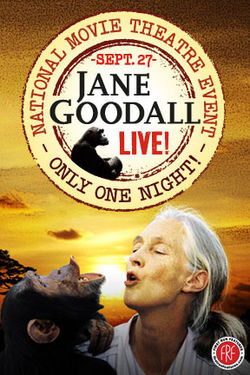
My mid-career walkabout continued tonight as I attended the nationwide simulcast of Jane’s Journey, a documentary of primatologist Jane Goodall written and directed by Lorenz Knauer. I went because her story of traveling to Tanzania in her twenties without a college degree to study chimpanzees under Dr. Louis Leakey has always inspired me. Likewise her writings and penchant for pithy quotes that I love so well, such as ” Lasting change is a series of compromises. And compromise is all right, as long your values don’t change.”
The event was part film screening, part this is your life, part Hollywood stars pay homage and part commercial for Jane’s current quest to inspire people to save the planet from damage humans cause. I thought the documentary was well done, particularly giving rare glimpses into her personal life including the often difficult effects of lifelong passion for work. As most driven people, she made sacrifices within romance, friendships and family. She spoke candidly about two marriages to “jealous” men who in her opinion kept her from doing the type of travel and work she does now. After her second husband died from cancer in 1980, she sought solace in the wilderness for four weeks and chose to be married to her work from then on. Deeply resonating for someone like me.
A period of separation from her son and grandchildren due to philosophical differences regarding the environment and commerce was also explored. Her son pursued commercial fishing and export of live crabs to Japan, which did not sit well with mother. He expressed remorse over those “lost years” chasing profits. Yet today he and his mother are working on an ecotourism venture together to take people to a pond called sacred by locals in Tanzania. It is filled with hippos that have been guarded by generations of the same family. Jane suggest that “high-end” clientele who “respect” the area will actually help increase financial stability for the area and offer more protection for the animals. I am not yet sold on this aspect of the film. The balance of moneymaking and mission with regard to culture and preservation is a theme that causes me angst almost daily. Jane didn’t help me find new insights on this.
While I am the first to tout the benefits of the marriage of pop culture and science to reach a broad audience, I didn’t feel seeing Courtney Cox, Angelina Jolie, Pierce Brosnan, Dave Matthews, Nancy Cartwright (voice of Bart Simpson) or Charlize Theron accomplished this very well tonight. Their segments seemed a bit disjointed and didn’t help the message as much as seeing a young reporter interview Jane about how young people can make a difference in the world. His unbridled enthusiasm for the topic spoke volumes for what young people can do.
While some scientists question her research methods, and there are criticisms of her focus on public appearances vs. hard science, Ms. Goodall still inspires me as she travels 300 days a year at age 77, making appearances and supporting projects at the Jane Goodall Institute. She does countless interviews, with her message of community action and education front and center, such as statements about women and science today in Huffington Post. The Roots and Shoots youth program, now in 100 counties, has me thinking of new ways museums might help organize and engage youth on a global scale.
Find Out More! Jane Goodall’s archives recently moved from University of Minnesota to Duke University, following Professor Anne Pusey, a long-time colleague. The Research Center has a wealth of information and educational activities for adults and kids alike.
 Museum Life
I just found your blog post after viewing the film on Netflix, and being troubled by the very thing you pointed out about the eco-tourism venture to the hippo pond. After feeling so inspired throughout the film, that scene toward the end sent me crashing down. I think this might be a case of a mother not seeing clearly when her son is involved. The idea that because a tourist is “high end” this somehow implies some greater moral compass and respect for nature is nonsense, and I could hardly believe such an otherwise intelligent person was suggesting such a thing. It came across as a rationalization for going forward with the plan. I can understand wanting to bring economic development to the local population, and tourism can do that, but it brings other problems with it, as well. I also would like to know what the locals think about this outsider’s idea for bringing groups of people to their sacred space. It sounded downright exploitive and totally out of character. What is to stop other entrepreneurs from deciding that they want to take more and more tourists to the hippo pond? Then suddenly we’re having to save hippos from development–Hippos that were doing just fine for “several hundred years” according to Goodall, herself, with the protection of a local family. “High end” tourists tend to like luxury, after all. And in large numbers they can’t help but have a negative environmental impact. Where will they put the hotel? Next to the eco-lodge? I still respect and love Jane Goodall and the work she has done through the years, but if she and her son go forward on this plan, I think she’s really lost her objectivity, and her way.
LikeLike